My wife and I are reading through the Psalms in our evening reading and occasionally a nugget of the Psalms jumps out of the page. Don’t you love it when, after years of reading the “Old Book” passages become alive, reinforcing old teachings or simply warming your heart.
This is the book of Psalms, and it is rich.
I pray I can communicate a portion of the blessing we receive from this wonderful book.
Psalm 74:20 Have regard for the covenant, for the dark places of the land are full of the habitations of violence. Psalm 74:21 Let not the downtrodden turn back in shame; let the poor and needy praise your name.
Asaph is continuing in his lament over the destruction of the tent of meeting/sanctuary, and in this verse, he comes to a plea for God to remember His covenant with Abraham. God has made promises to the nation that seem to be failing under the watchful eye of Asaph, and he now pull the contract out, and lays it before the Lord.
Is this a move that could be interpreted as insulting, as if the Lord, the all knowing has forgotten something, even forgetting something as important as His word for His people? Is Asaph making a move that is too pushy, too “in your face” before the Lord?
I think not. It seems God relishes the faithful to remind Him of His Word, to recount of His promises to those who seek to know His will.
Isaiah 62:6-7
On your walls, O Jerusalem, I have set watchmen; all the day and all the night they shall never be silent. You who put the Lord in remembrance, take no rest, and give him no rest until he establishes Jerusalem and makes it a praise in the earth.
An amazing passage, as Isaiah is speaking of those in Jerusalem who are constantly pleading with and reminding God of His word, or His promises to the nation.
Jesus spoke also of the characteristic of the believer, describing the saint as one who never stops “bothering” God.
Luke 18:2 He said, “In a certain city there was a judge who neither feared God nor respected man. Luke 18:3 And there was a widow in that city who kept coming to him and saying, ‘Give me justice against my adversary.’ Luke 18:4 For a while he refused, but afterward he said to himself, ‘Though I neither fear God nor respect man, Luke 18:5 yet because this widow keeps bothering me, I will give her justice, so that she will not beat me down by her continual coming.’”
This widow was seeking justice, seeking for righteousness to be performed before a judge who cares little about the problem. How are we to interpret this story of Jesus when our Judge is ONLY concerned about justice, when our Judge is Righteousness Himself?
We could sit back, and knowing that our God is Righteous, that He is a Judge who will make things right, and rest in this fact. But the Lord speaks of His people “bothering” the Lord, pestering Him, and bringing His Word before Him, reminding Him of the relationship we have, of the promises He has graciously given, and that we trust in.
Asaph was doing what God wanted, facing an incredibly difficult time, yet finding refuge and hope in the promise of God.
May we take instruction from this saint of old, and continue to be before the Lord, reminding Him of His great promises, and thanking Him for the greatest fulfillment of His promises, Jesus our Savior!
2 Corinthians 1:20 For all the promises of God find their Yes in him. That is why it is through him that we utter our Amen to God for his glory.
Yes – Jesus is all of it, and as we grow to know Him, we find He is the promise we can rely on, even in dark days when all is falling apart, when the very sanctuary of God seems to be in tatters. He is still the complete fulfillment of all of God’s promises for His people.
My hope is that this series will offer my readers a chance to consider the names, characteristics and descriptions of our God in the Word.
The remaining Names of God in this series might be considered descriptors, or characteristics of the Lord. We have reviewed the three primary Names of God, along with nineteen compound Names of God in our previous posts. As we venture through these descriptors of our God, I hope we will recognize all the many characteristics of our God that we tend to take for granted.
The Word is truly rich with descriptions of the Living God, and this effort of searching in the Word was quite illuminating. He truly is the ultimate subject of the Word, and His revelation of self-descriptions, or the accolades offered Him by His priests, prophets, kings apostles and faithful truly is a blessing.
May the Name of the Lord be praised, and by thinking on His name, may you have a blessed day.
268
Greater than the Temple
Matthew 12:6 I tell you, something greater than the temple is here.
Jesus walked amongst people who were devoted to the temple. Even the most “unwashed” of the nation reverred the temple, though they despised those who abused their power within it. The Temple was the glory of the city of Jerusalem, and represented a time when the very presence of God was with the nation.
Those days had passed, and the glory of this temple was merely physical, for the Lord had left the Temple centuries ago, prior to it’s destruction by the Babylonians as Ezekiel witnesses in his vision he recorded in Ezekiel 10.
After the completion of their captivity, the Lord provided the opportunity for the Jewish remnant to return to the land, and rebuild the temple. Some of the elders of the nation, that had seen the first temple of Solomon, wept when they saw the foundation of the Second Temple.
Ezra 3:12 But many of the priests and Levites and heads of fathers’ houses, old men who had seen the first house, wept with a loud voice when they saw the foundation of this house being laid, though many shouted aloud for joy,
Those who witnessed the first, were weeping, not necessarily out of joy for the rebuilding progress, but because this temple was smaller than Solomons. The required resources to rebuild Solomons temple were not available, and the temple would be a dim reflection of the first one.
And yet, in the building of the temple, as the people were dismayed and discouraged, a prophet by the name of Haggai appeared on the scene. He spoke of the temple, the need to construct, the refusal to compare with the old memories and of the glory of this second temple.
Haggai 2:9 The latter glory of this house shall be greater than the former, says the LORD of hosts. And in this place I will give peace, declares the LORD of hosts.’”
Facing a temple reduced in size and in resources, Haggai had the nerve to say it’s glory would be greater than Solomon’s temple. Surely you jest Haggai, for it is but a mere echo of the glory of Solomon’s temple.
Five hundred years later, a young Rabbi entered that second temple and as He spoke to the building managers (the Pharisees) about the Sabbath – a tremendously important day for them – He declared Something greater than the temple was present.
Talk about nerve!
But could Haggai have been thinking of more than the size or cost of the physical temple when he prophesied? It seems the elders who wept at the reduced foundation size of the second temple were distracted from the truth. The Messiah would out shine any building, and beyond that, He would BE the temple.
Such an audacious statement concerning His superiority over the temple must have stunned the crowd. Stunned them, or at least confused them as they continually looked to the building as their focus of allegiance.
But our Messiah goes further. His statement concerning the raising up of the temple, though thoroughly misunderstood, was proven by His resurrection.
John 2:19 Jesus answered them, “Destroy this temple, and in three days I will raise it up.”
He is the Temple of the Living God. No building could compare to the Glory of the Son, and any effort to construct any temple in the future is spitting in the face of the Father’s gift to all mankind.
Let us consider how we, as believers in the Body of Christ are to focus on Him only. He is the Temple and any building we meet within is simply a shell to protect us from the elements.
Remember – even today, He is Greater than the Temple.
I would love to hear of your favorite name, characteristic or description of the Living God. Please leave me a comment, and I will include it in the list!
Thanks again for coming to visit. I hope you found something of interest in this post and would appreciate a comment, to begin a discussion. If you know someone this blog may bless (or challenge), send them a link, so they may join us in our discussion.
Philippians 2:12 Therefore, my beloved, as you have always obeyed, so now, not only as in my presence but much more in my absence, work out your own salvation with fear and trembling,
Sorting through my past posts on this topic and was quite surprised that I hadn’t dedicated a posting to the verse above. How could I have missed a passage that provides support for the conditional security such as this one?
Consider the verse, and try to understand the heart Paul had in writing it. He loved this church, likely more than any other church he had birthed. He sought the best for them, and even in this verse, he expresses confidence that the saints were obeying. Note that he does not say that he was confident that the saints were believing. No no no.
If Paul was to encourage a saint, he looked to the fruit of obedience for topic matter. Believing can be so “malleable”, but acts of faith, of service and of spiritual worship are forged in the indelible framework of time and can not be revised, edited or interpretated with alternate understandings. The works that are past are fixed in time and provide proof of what is important to the one being examined.
Paul had examined these saints while he was amongst them, and saw that their obedience was giving evidence of the faith they espoused.
Now he seeks their continued obedience, as he encourages them with the challenge to work out their salvation. With fear and trembling.
Now I can not tell you what was going on in the recesses of Paul’s mind at the time of this writing, but a guess would be that there was something to fear if these saints did not work out their salvation.
Philippians 2:13 for it is God who works in you, both to will and to work for his good pleasure.
Of course my Calvinistic brothers would refer to the very next verse to remind us that it is God who is working in the believer, and for that I am eternally thankful. God is a faithful God, a loving and caring God who seeks our best.
But the passage does not say that God forces His work into our lives, or that we have no choice in the matter. God is present, He is powerful, and He seeks our best, but as I and my Calvinist friends agree on, we are a sinful people – a people that tends to walk away, to ignore the whispers of God, to forget His promises and take the easy road to often.
God is working in our lives and as we obey we have many many blessings in our lives, most of which is the knowledge of the Living God being active and personal in our own soul. This is an incredible truth, and one which we should treasure.
So why did Paul mention fear and trembling? Let’s think about this for a moment.
If we are a people that are eternally secure, disobedience causes the loss of eternal rewards. I cannot number the times I used this reasoning in my former belief was that. I simply did not entertain the thought that disobedience would potentially strain or fracture a relationship with the Father and Son. No – that did not fit my thinking at that time, for I was committed to a salvation that was of a contractual nature, and not of the relational nature.
But let’s suppose I am incorrect in my current understanding, and salvation includes the teaching of eternal security. Once saved always saved! Let’s assume OSAS is true for a moment. If so, I suppose one way Paul might have motivated the saints in Philippi would be to instruct him to work out his salvation with self interest and a “godly” desire.
Paul could remind the believer of his rewards! Admittedly the loss of rewards would bring shame on the believer before the throne, but wouldn’t Paul’s message resonate with the faithful Philippian saint by appealing to the rewards as opposed to the fear and trembling of loosing that relationship with the Father. It is in the interest of the saint to gain more rewards!!
I know – that is crass, vulgar and not called for. But you get my point.
We are to work out our salvation with a fear and a trembling that is settled in our soul, a fear that our old nature may rear it’s ugly head and we pay attention to it. We are a people that are easily distracted by the the lusts of the flesh, the world and the pride of life!
1 John 2:16 For all that is in the world–the desires of the flesh and the desires of the eyes and pride of life–is not from the Father but is from the world.
We are a people who are to fear, even tremble at the thought of not pleasing the One who calls us to Him. Is this a debilitating fear, a trembling of heart that cripples us into inaction? If this is your continual experience, I dare say the fear and trembling you are experiencing is not of the Father. Yes – there may come times when the realization of how great He is knocks us down, floors us before Him. The prophets of old experienced this often. (See Psalms for Psome – Ps 36.00 for a discussion on men of old facing God and falling down!)
Yet they rose up and did mighty things. His is the invitation to a life of adventure, of listening to His will and walking in obedience.
Who cares about rewards when we can walk with the Almighty, and experience His loving care.
Thanks again for coming to visit. I hope you found something of interest in this post and would appreciate a comment, to begin a discussion. If you would like to receive daily posts from Considering the Bible, click on the “Follow” link below
As many who have followed me for a bit, I have fallen into the Psalms, and I can’t get up! (As if I would want to.) The Psalms are a majestic collection of poetry, of heart felt human experiences that constantly challenge me in my own frail attempt to follow the true King. As many of the Psalms are written by David, my study on the Psalms has spurred me on to looking at the life of David, is the main contributor to this book, and to follow the victories and tragedies of the shepherd King of Israel.
Many times in the narrative, we will see the Lord Jesus, imperfectly, yet a reflection of His spirit in a man with weaknesses.
2 Samuel 6:16-19 16 As the ark of the LORD came into the city of David, Michal the daughter of Saul looked out of the window and saw King David leaping and dancing before the LORD, and she despised him in her heart. 17 And they brought in the ark of the LORD and set it in its place, inside the tent that David had pitched for it. And David offered burnt offerings and peace offerings before the LORD. 18 And when David had finished offering the burnt offerings and the peace offerings, he blessed the people in the name of the LORD of hosts 19 and distributed among all the people, the whole multitude of Israel, both men and women, a cake of bread, a portion of meat, and a cake of raisins to each one. Then all the people departed, each to his house.
Michal, David’s first wife, the youngest daughter of Saul didn’t join David in this effort to bring the Ark of the Lord back to the center of Israel’s public life.
This effort to retrieve the Ark of the Lord appears to be of no real importance to her, for she remaining in the Kings house during this celebration. Of course, David may have instructed her to stay back, for fear of another judgement falling on some that are near the ark, but that seems highly unlikely. Her staying back, while all of Israel was joining in on the festivities and celebration seems to tell us a bit about this lady.
First, she had no desire to be involved with the God of Israel. We would do well to remember that Michal was raised in a family that was led by a man who suffered from fits of insanity. He was driven by jealousy, and at least once, resorted to the guidance of a witch. He abandoned God years before, and his life reflected that of a man out of control.
Secondly, she was better than the rest of Israel. I speak this sarcastically, in that she did not join David amongst the people of Israel. It is instructive to note that the text speaks of “the people”, “the whole multitude of Israel” and “all the people”. Also the text speaks of her looking out on the procession, and especially on David. This term often speaks of looking down, or looking out and down, or to look down on. Now it may reflect the notion that she was simply physically on a second floor, or a raised structure, but due to her inner reaction, I am seeing a self loving, privileged woman in Michal.
She had no desire to be with the God of Israel, and no desire to be amongst the “riff raff”, those ordinary people. She seemed to like being away from others.
It turns out she got what she wanted, for she died as a lonely childless woman.
David, on the other hand was in the midst of the procession, having removed his royal clothing, dancing and leaping before the Lord. After the procession had completed the safe transport of the Ark t the Temple, David offered offerings to the Lord.
I assume this is not David directly making the offerings, as this action was the sole responsibility of the priests. His part in the offerings was to supply the offerings. Nevertheless, the celebration centered on two types of offerings.
Burnt Offerings
The burnt offering is the sacrifice of a complete, unblemished male animal, totally burned on the altar. Prior to the consumption of the fire, the animal was to be skinned, with the hide given to the priests. The sacrifice represented the complete offering to God for atonement for sin, to satisfy God’s wrath, and a total surrender to the will of God.
This is a monumental action on the part of David and all of Israel, for this burnt sacrifice had not been offered for decades by the nation. To bring the Ark back into the tent meant all other actions associated with the worship of God was available to the people, and this lapse in worship by the nation needed to be confessed before the Lord.
Peace Offerings
The peace offering was an sacrifice that represented fellowship between the Lord, His priest’s and the people. The offering represented a reconciliation between the people and the Lord as they shared in the consumption of the offering. Although there were variations on the peace offering, for David to take part in this offering speaks of his understanding that the nation was in good standing with the Lord, that the sacrifice of the burnt offering had been accepted.
Out of this period of reconciliation to the Lord came a celebration of blessing on the people. Food was distributed to the people of Israel, and there was much rejoicing.
It was a fantastic day of rejoicing and reconciliation. David must have been on top of the world. But as it is with so many spiritual high times in our lives, the enemy will immediately seek to tear us down with those he can influence. And as he went home, David would have to meet up with Michal, a self loving privileged woman.
It is stories such as this one that highlight the great blessing of a family being one in worship, one in allegiance and one in dedication to the Father of the Lord Jesus.
Thanks again for coming to visit. I hope you found something of interest in this post and would appreciate a comment, to begin a discussion. If you know someone this blog may bless (or challenge), send them a link, so they may join us in our discussion.
Jesus in the Old Testament is a series of posts that will offer my readers a chance to consider pictures or shadows of Jesus in the Old Testament. As mentioned in the introduction to this series, some may be obvious, some may be not so obvious, and some may simply be a facet of the Lord those reading may not have considered previously.
I hope as we venture through this series, we will see the Lord in many wonderful pictures throughout the Old Testament.
SEEING JESUS IN
Cyrus
Trigger of Prophecy
Daniel 9:25 Know therefore and understand that from the going out of the word to restore and build Jerusalem to the coming of an anointed one, a prince, there shall be seven weeks. And for sixty-two weeks it shall be built again with squares and moat, but in a troubled time. Daniel 9:26 And after the sixty-two weeks, an anointed one shall be cut off and shall have nothing. And the people of the prince who is to come shall destroy the city and the sanctuary. Its end shall come with a flood, and to the end there shall be war. Desolations are decreed.
Luke 19:38 saying, “Blessed is the King who comes in the name of the Lord! Peace in heaven and glory in the highest!”
Cyrus made a decree, and that decree began the reestablishment of the nation of Israel in the promised land. It is as if the nation was reborn, and the hope of the Messiah could be realized again.
Cyrus issued a decree, and as we spoke of earlier, this decree to release the Jews from captivity and provide access to the homeland in order to rebuild the temple was miraculous! What type of king does this type of action for a defeated people?
He issued a decree, but it is very improbable that the decree of Cyrus is related the the word spoken of in Daniel 9:25. You see, all the previous passages we have spoken of in relation to the decrees of Cyrus have had to do with the rebuilding of the temple. Daniel speaks of a decree to rebuild the City. Let us not blur the Word!
Yes, some may consider a verse in Isaiah justify seeing Cyrus as the one providing the decree referred to in Daniel 9:25.
Isaiah 44:28 who says of Cyrus, ‘He is my shepherd, and he shall fulfill all my purpose’; saying of Jerusalem, ‘She shall be built,’ and of the temple, ‘Your foundation shall be laid.’”
But take note that the text speaks of God describing Cyrus as a shepherd, and then of God’s actions of Jerusalem and the temple being rebuilt. It is not specifically stating Cyrus would perform the actions of building Jerusalem or laying the foundation of the temple.
The Word does help define exactly Cyrus place in all of this process of reestablishing the nation of Israel, as Ezra describes the historical proclamation of Cyrus.
Ezra 1:1-2 In the first year of Cyrus king of Persia, that the word of the LORD by the mouth of Jeremiah might be fulfilled, the LORD stirred up the spirit of Cyrus king of Persia, so that he made a proclamation throughout all his kingdom and also put it in writing: “Thus says Cyrus king of Persia: The LORD, the God of heaven, has given me all the kingdoms of the earth, and he has charged me to build him a house at Jerusalem, which is in Judah.
After a careful reading, it should be obvious that Cyrus provided the decree for the temple, and that nothing is spoken by him regarding the rebuilding of the City of Jerusalem.
So Carl, you have just disproven the expected storyline of Cyrus being the one who would be the “Trigger of Prophecy”, that he would set in motion the specific decree that could calculate the coming of the Anointed One, the Prince.
Yes, Cyrus did not provide the decree to build the City, but he set in motion the inevitable process of Israel becoming a nation in the land again. Some other king – we will look at him in the future as a type of the Christ also – had the privilege start the clock for the countdown to our Saviors appearance, His passion and His glory.
For now, we are considering Cyrus, and as a type of the Christ, he has abundantly surprised me in all the ways he pointed us to the who are looking to find the Christ in the Old Testament.
Thanks again for coming to visit. I hope you found something of interest in this post and would appreciate a comment, to begin a discussion. If you know someone this blog may bless (or challenge), send them a link, so they may join us in our discussion.
My hope is that this series will offer my readers a chance to consider the names, characteristics and descriptions of our God in the Word.
The remaining Names of God in this series might be considered descriptors, or characteristics of the Lord. We have reviewed the three primary Names of God, along with nineteen compound Names of God in our previous posts. As we venture through these descriptors of our God, I hope we will recognize all the many characteristics of our God that we tend to take for granted.
The Word is truly rich with descriptions of the Living God, and this effort of searching in the Word was quite illuminating. He truly is the ultimate subject of the Word, and His revelation of self-descriptions, or the accolades offered Him by His priests, prophets, kings apostles and faithful truly is a blessing.
May the Name of the Lord be praised, and by thinking on His name, may you have a blessed day.
267
Greater than Solomon
Matthew 12:42 The queen of the South will rise up at the judgment with this generation and condemn it, for she came from the ends of the earth to hear the wisdom of Solomon, and behold, something greater than Solomon is here.
This general passage has been referred to earlier in our discussion of “Greater than Jonah”. In that comparison, we saw that Jesus referred to Jonah in relation the the effect of his preaching, and of the repentance Jonah experienced amongst the dirty sinful gentiles.
It seemed Jonah was much more successful with the dirty rotten stinking gentiles that Jesus was with the righteous, holy, blessed and perfect Jews He was addressing. Of course Jesus is much much greater, but refer to that posting for that discussion!
In our verse this morning, Jesus brings up Solomon. The wisest and richest king ever produced in the nation. A man revered by Jesus audience as the wisest of all, a man who drew people to him just to hear his judgements. Jesus focuses in on the story of the queen of the South coming to see Solomon.
A woman. A woman from a foreign nation. A dirty rotten stinking gentile again! But this example had her coming to Israel. She was not as the Ninevites, having a message delivered that they did not expect. This queen sought out an audience with the king.
And she is going to judge the generation of religious Jews for not paying attention to the One greater than Solomon.
Can you hear the mocking, the jeering and the laughter in the background?
How could this itinerant rebel rousing Rabbi consider His message greater than Solomon? Or more to the point, how could Jesus compare Himself as greater than Solomon? This must have seemed completely ludicrous in the eyes of the religious man in Israel!
And how dare Jesus suggest a foreigner, a dirty rotten stinking gentile, judge the righteous holy and perfect law-abiding Jew?
This was just too much!
But what if He was right? What if Jesus is Greater than Solomon?
How humbling this would be for the religious man?
If Jesus is greater than Solomon, and the religious man is not recognizing His greatness, a time will come when a great humbling will occur!
How deep is the complete blindness of the religious man?
If Jesus is greater than Solomon, and the religious man cannot see the truth of the Messiah, that Jesus provides all the proofs needed to know and see Him in His person, a time will come when this will be revealed!
How silent is the stone cold deafness of the religious man?
If Jesus is greater than Solomon, and the religious man cannot hear the words of God coming from the mouth of Jesus, he is showing he is not of the fold, that he is not one of the Shepherd’s sheep, a time will come when the Word will be clear!
My friend, Jesus is Greater than Solomon, having proved His identity by His life and death, and His resurrection.
Jesus is Greater than Solomon. Deal with it!
On a personal note, I am convinced that religion is one of the greatest barriers to knowing the Living God. Religion, in all it’s glory, is often a tool used deaden our sense of need before the only True God, providing a system of various laws and rules that we are to obey in order to satisfy some god, or provides the religious man enough information in order to inflate our estimation of ourselves.
I would love to hear of your favorite name, characteristic or description of the Living God. Please leave me a comment, and I will include it in the list!
Thanks again for coming to visit. I hope you found something of interest in this post and would appreciate a comment, to begin a discussion. If you know someone this blog may bless (or challenge), send them a link, so they may join us in our discussion.
A little while ago, I produced a verse by verse series in Philippians. I really enjoyed that exercise and have been wondering if I should take on another book. Well it turns out that 1 Thessalonians is the victim of my machinations, and hopefully, the thoughts produced by this fantastic book will edify and encourage the reader.
As with Philippians I am going to limit each post to one verse, and hopefully produce a short, succinct read for my friends who follow.
1 Thessalonians 3:8 For now we live, if you are standing fast in the Lord.
Paul’s life was conditioned on the standing fast of the Thessalonians.
Is that what he wants the Thessalonians to understand or is that only what a “literalist” would understand? As a former literalist, I tend to initially fall into extreme understandings of poetic expressions, and admittedly thought this ridiculous interpretation for a moment! For a discussion on the literal interpretation of the Word, consider a short 2 part series I published a few years back. A Literal Bible – Part 1 & A Literal Bible – Part 2
Obviously, Paul was expressing a quality of spiritual life he entered into upon the notification of the Thessalonians ongoing commitment to the Lord. He opened up to them of the joy he experienced, the spiritual energy and abundance he received upon knowing of their continued trust in the Messiah, of their faithfulness to God.
But Paul used the term “if”! What is Paul trying to say here Carl?
For some who follow this blog, they may recognize that Conditional Security is discussed in a series I have been developing since 2022. Each week, a passage is considered in relation to the conditional security of the believer, and 1 Thessalonians 3:8 definitely entered the litany of passages considered.
First off, let us not consider this verse to imply Paul was using this verse as a fulcrum to maintain, manipulate or influence the Thessalonians in continuing in their faith. I think he simply wanted the believers to know of the impact of their faithfulness on a man that had told them good news.
This is a recurring theme in these current verses. Paul is expressing his heart to a people that he loved. He wasn’t upbraiding them on some heresy, or correcting them on a moral failure or rebuking them on division within the group. Yes he would address their misunderstanding of the second coming of the Lord, but this was the bulk of his concerns theologically. He was baring his heart, and connecting with a small group of believers the best way he knew, given the circumstances.
If my reader is curious regarding the conditional term “if” used within the Word in relation to the believers responsibility before the Lord, I would refer you to the series noted above.
Psalm 34:6 This poor man cried, and the LORD heard him and saved him out of all his troubles.
As many who follow may know, I have had the privilege to know the Lord for over 40 years. During those decades, He has proved Himself to be a faithful, kind and loving Savior. And as I have learned to lean on Jesus, He has shown Himself to be a merciful Savior, never wavering, even in some very dark times.
This topical series will try to provide a snapshot of an ol’ fools prayers, the weakness and selfishness of his prayers, and the ever increasing goodness of God in His responses the those prayers.
I hope my witness to the goodness and faithfulness of God will be an encouragement to those reading, and will spur us all on to a deeper, more consistent time of being in the Lord’s presence.
Please visit with me as I tell the story of a faithful God and His care for an ol’ fool. Though David considered himself a poor man, I freely admit, I am just an “ol’ fool” looking to the Lord.
At the Couch
Introduction
In our last post, I spoke of offering conditions as a part of our prayer life. I seemed to lean into this style of praying for many years, and to be honest, I seem to slip into “bargaining” with God more than I want to admit.
After a bit of reflection, this style of communicating with my Father implies a number of problems.
A severe lack of trust. I simply need to have some control in the situation, as I am reluctant to let go of the problem. I am not convinced inside that He will take care of the problem, that He will provide an acceptable solution, or that He understands what I want! This is ludicrous, since He is the Creator, and the Sustainer, and He knows my heart and mind better than I. Yet I want to negotiate. Foolishness.
A severe lack of love. Of course many may think I am referring to my lack of love for my Savior, and of that I confess my shortcomings. But that is not what I am referring to in this point. As I negotiate with my Father in my prayers, I am exhibiting an understanding of the Father’s love for His child that is wholly inadequate, insulting and repulsive.
For those who have a child, consider, if you will, your own child coming to you, in need and unable to fix a situation. This child is helpless, ignorant of all that is going on in the family, and without the skills to gain a solution, little less maintain the life he or she lives. This child is completely dependent on the Father for his sustenance, for his protection, for his well being and his environment.
And this child comes to negotiate with you, trying to impress you with a promise, or worse yet a threat.
How ludicrous! It is as if the child considers himself on the same level, even as an equal to the Father. Incredulous!
To bargain with God reveals a lack of trust and a lack of understanding the love of God as our Father.
This understanding came home to my mind and heart clearly in the following prayer I want to recount to you.
The situation
We were strangers in a foreign land, and until all the paperwork gets filed, and all the forms are filled out, we were essentially guests in this nation. During this time of being guests, three of my children were detained and set on the course for deportation.
This story is about my daughter.
We came back from a family vacation in Mexico, and due to my daughter needing a medication for a condition, had some pills in the bottom of her purse. As we crossed the border into the USA, an agent found a pill, and pulled her to a separate room.
Within 10 mins, we were experiencing the nightmare of deportation again. (We had lost one son to deportation, and a second son had spent an extended time in deportation jail before being released. Now a third child. Although she was a strong young lady, she was not ready for the trial we were to go through.
By this time, both my wife and I were at our wits ends, desperate for relief, constantly in fear of hearing of our daughter being hurt in the jail, or of paperwork being lost and forcing the deportation prior to due process being completed. Our nerves were frayed and every minor life disturbance was magnified in our minds. We prayed every day, morning noon and night. We begged, pleaded and sought to find ways to get God working. We needed our daughter home.
Except I had not let go yet.
I was up early one morning, sitting on the couch, praying for the return of my daughter. The paper work was not progressing, the lawyer spoke of snags in the process, of the judge being difficult, of the courts being backlogged. I again pleaded with God to bring her home.
And then I realized He may need to take her away. It was a condition I had refused in my heart, a possibility I had never allowed to enter my thoughts. God had to bring her back.
He had to!
What did I need to offer to Him to get this result? How could I manipulate the Lord of All? I was in negotiation with my Creator, and it wasn’t going well!
That morning, I turned to kneel at the couch, and offered my daughter to the Lord, for His will to be complete in her life, for His glory. I laid down my wishes. May He do as He will, and may we be willing to follow no matter.
I would like to tell you that peace flowed through my soul, that my mind and heart felt at ease for the first time in months. I can’t confess that. I only knew that He was in control, that I was broken, and that He was working in the situation to accomplish His goals for my daughter and our family.
Months passed. Our prayers turned from desperation to simple requests. We began to see movement in the courts. As I had touched on this topic in a previous post (Let Me Tell You a Story – Disappointment), let me recount the courtroom proceedings from that posting.
After two court appearances, my daughter was asked to stay behind. The judge was like a machine with all the other subjects, spitting out decisions rapid fire, sealing the fate of many. When it came to her, the judge cleared the room, leaving only my wife and I with her. He proceeded to upbraid the injustice that had occurred in this incarceration, and declared her to be freed immediately. She was coming home!
Prayer changes things. Prayer changes people.
God is good. He loves us when we are negotiating, untrusting, willful and stubborn. It is so much better to fall on His mercy and love instead of fighting it to get something that may not satisfy.
May we all seek to comply with the will of God in our lives, no matter the immediate loss we may think we will experience.
Thanks for joining and Considering The Bible with me. Your thoughts are always welcome, and I look forward to hearing of the faithfulness of God in your lives.
My hope is that this series will offer my readers a chance to consider the names, characteristics and descriptions of our God in the Word.
The remaining Names of God in this series might be considered descriptors, or characteristics of the Lord. We have reviewed the three primary Names of God, along with nineteen compound Names of God in our previous posts. As we venture through these descriptors of our God, I hope we will recognize all the many characteristics of our God that we tend to take for granted.
The Word is truly rich with descriptions of the Living God, and this effort of searching in the Word was quite illuminating. He truly is the ultimate subject of the Word, and His revelation of self-descriptions, or the accolades offered Him by His priests, prophets, kings apostles and faithful truly is a blessing.
May the Name of the Lord be praised, and by thinking on His name, may you have a blessed day.
266
Greater than our Hearts
1 John 3:20 for whenever our heart condemns us, God is greater than our heart, and he knows everything.
John is providing multiple tests for the believer to recognize in his own life, to build his faith and establish his life before God. I had at one time thought the book consisted of one verse, and that verse being 1 John 5:13.
1 John 5:13 I write these things to you who believe in the name of the Son of God, that you may know that you have eternal life.
It’s almost funny how I would skip through John’s letter, stopping shortly in the first chapter to memorize the ninth verse, and then right to 5:13. It was my verse to depend on based on what I remembered happened so many years ago, when I bent my knee at that couch and prayed the sinners prayer.
Chapter 5, verse 13 was critical for my faith since at one point in my life I had believed. Yes, back on Feb 21st of 1981, at 7:30 I prayed to the Lord. It was my salvation, and John was telling me that because I believed, I may know I had eternal life.
But I skipped the body of his letter, hoping the prayer would be enough. Now before anyone starts thinking I am questioning whether I met the Lord that night, let those thoughts evaporate. He saved this ol fool’s life and put me on a new road, with a new heart and a new purpose.
Yet I depended on that night! It was if the night was what saved me in my thinking sometimes. I am not sure if anyone else has had these thoughts, or possibly some doubts of their initial introduction to the God of Eternity, but John wants to dispel those thoughts. He provides us a fool proof method of knowing of our destiny, of our relationship with the Savior and that knowledge is found in the way we live out our faith.
Nothing changes the past. Those times when I have obeyed the light He give (1 John 1), loved my brother (1 John 2), rejected the world’s enticements (1 John 2), refused anti-Christian teaching (1 John 2), sought a purity of life (1John 3), or found the world hates or reject me (1 John 3) – each of those times has given me a greater confidence in my relationship with the Risen Son. It is an experiential relationship with the Living God that provides the knowledge of our faith.
Yet we are dragging about a sinful rebel, one that simply wants to wander off from the God we love. Each of us have failed Him. Each of us are not worthy.
There are times when my history with the Lord wells up in my heart, when my memories flood in and show how lackluster my faith has been, of how I have been an inconsistent follower, a complainer, a charlatan of sorts, a hypocrite and a traitor.
My heart is a condemning heart. It is the nature of the beast! And John tells us that when our hearts condemn us, God is greater than our hearts, and He knows everything.
The epistle John is writing is for believers to know of their relationship with the Living God. John now refers to God knowing everything.
This is the only time John mentions “God knowing” in this epistle, and it is instructive to note he is addressing the believer who is self condemned, full of doubt and despair. Even in this state of condemnation, of our hearts refusing to acknowledge the leading of God in our lives, we can find reassurance in the Lord, remembering that He knows our souls, and that He is above all of our doubting self condemnation.
1 John 3:19-20 By this we shall know that we are of the truth and reassure our heart before him; for whenever our heart condemns us, God is greater than our heart, and he knows everything.
Our God is Greater than our heart, and for that we should continually be a thankful people. When the condemning heart starts telling dark stories – whether they be true or not, remember the goodness of God.
I would love to hear of your favorite name, characteristic or description of the Living God. Please leave me a comment, and I will include it in the list!
Thanks again for coming to visit. I hope you found something of interest in this post and would appreciate a comment, to begin a discussion. If you know someone this blog may bless (or challenge), send them a link, so they may join us in our discussion.
Revelation 14:9 And another angel, a third, followed them, saying with a loud voice, “If anyone worships the beast and its image and receives a mark on his forehead or on his hand, Revelation 14:10 he also will drink the wine of God’s wrath, poured full strength into the cup of his anger, and he will be tormented with fire and sulfur in the presence of the holy angels and in the presence of the Lamb. Revelation 14:11 And the smoke of their torment goes up forever and ever, and they have no rest, day or night, these worshipers of the beast and its image, and whoever receives the mark of its name.” Revelation 14:12 Here is a call for the endurance of the saints, those who keep the commandments of God and their faith in Jesus. Revelation 14:13 And I heard a voice from heaven saying, “Write this: Blessed are the dead who die in the Lord from now on.” “Blessed indeed,” says the Spirit, “that they may rest from their labors, for their deeds follow them!”
Revelation is a difficult book to understand. There – I said the obvious.
In my early years, I was of the mind that John had written the book of Revelation, his magnum opus of apocalyptic Scripture, for the saints in our modern times. I was so selfish, so self centered that I was convinced John must be speaking of the 21st century, and of the conditions believers would face over 2000 years after his death!
That is until I realized the incredible impact the Old Testament had on John as he wrote the Book of Revelation. Of all the New Testament books, none is so dense with allusions, references and quotations from the Old Testament as is this book we are reading this morning.
A case in point to consider.
John refers to a mark on the head or hand. Is John possibly thinking his readers may know the Old Testament well enough that this reference reminds them of an earlier time, a time that may have similar characteristics?
My first thought would be the mark God called for on the mantle of each Israelites home on the night of the first passover.
Exodus 12:7 “Then they shall take some of the blood and put it on the two doorposts and the lintel of the houses in which they eat it. Exodus 12:23 For the LORD will pass through to strike the Egyptians, and when he sees the blood on the lintel and on the two doorposts, the LORD will pass over the door and will not allow the destroyer to enter your houses to strike you.
The Israelites definitely understood the idea of marking, and that it was a representation of protection. But Ezekiel goes even further, and I think John may be reaching back to this prophet for his context!
Ezekiel 9:3 Now the glory of the God of Israel had gone up from the cherub on which it rested to the threshold of the house. And he called to the man clothed in linen, who had the writing case at his waist. Ezekiel 9:4 And the LORD said to him, “Pass through the city, through Jerusalem, and put a mark on the foreheads of the men who sigh and groan over all the abominations that are committed in it.” Ezekiel 9:5 And to the others he said in my hearing, “Pass through the city after him, and strike. Your eye shall not spare, and you shall show no pity.
After this man clothed in linen performed his task of identification, judgement fell! But note the very next verse, where those who were to show no pity were to begin the killing!
Ezekiel 9:6 Kill old men outright, young men and maidens, little children and women, but touch no one on whom is the mark. And begin at my sanctuary.” So they began with the elders who were before the house.
At God’s sanctuary! The killing was to begin at the very location where those who have the appearance of godliness congregate. And what was the mark identifying? The mark was on all those who mourned and groaned over the apostacy in the nation, over the abominations the Israelites performed, even in the sanctuary of God.
An incredible judgement of God occurred during Ezekiel’s time.
Is John using this message, and applying it to believers in relation to the taking of a mark, instead of simply accepting a mark of identification? After all, believers are already marked!
Revelation 22:4 They will see his face, and his name will be on their foreheads.
John clearly brings in hints of Ezekiel in this passage, and it may be instructive that Ezekiel’s judgement started in the sanctuary. In the very house of God!
In Ezekiel’s passage, the mark was provided for protection, for those who mourned the condition of the temple and the sanctuary, the religious state of the nation. In Revelation, this mark is accepted by those who chose allegiance against God and Jesus.
Ok – I can hear the question even now. Is it a physical mark we are to fear?
If it gets to that point where a believer is to make a decision of receiving a mark, (whatever that may be), I am afraid we may be too far gone.
You see, for as those in the Ezekiel passage are described, the mark identifies the type of person it is placed on, and it is not the result of a single decision of accepting a mark. As believers, our allegiance is to the Christ today, and though fundamentally this is not an external condition, it is also not simply the absence of a mark, or the absence of a laser imprint, or the absence of a chip inserted into a hand or on your forehead.
Our allegiance, that which “marks us” even today, should be seen in our good works which glorify our Father. These exterior “marks” are sourced from an internal faith buried deep in our minds and hearts. Our faith in the Risen One produces decisions of the mind (represented by the forehead in our passage) and actions in our lives (represented by the right hand in our passage) that reflects a living faith!
We already have His mark on us! We are marked as sons and daughters of the Most High God by the Messiah, and unless some other mark is more appealing, more satisfying, or more desirable in the eye of the beholder, we will not desire any other!
Yet the passage in Revelation does not simply state what I have described and walked away. John continues with a statement that should be accepted for what it is, a challenge that needs to be overcome in the faith.
Revelation 14:12 Here is a call for the endurance of the saints, those who keep the commandments of God and their faith in Jesus.
His call for endurance is not an idle statement, for their may be days ahead when the enemy makes threats, when the enemy seeks to feed our fears, when the enemy will challenge our resolve to follow the Crucified One.
Story Time
One such time for this family was a few years back, when the world was in the deep confusion of Covid, when all was falling apart and ignorance and misinformation was rampant. There were forces that sought to have control over this family, to take advantage of this condition of fear and confusion.
The threat I speak of for my wife and I was the loss of my career. We are fundamentally a one income family, and when I was challenged to take a jab, I humbly refused. Many temptations and justifications tumbled through my mind, with my boss seeking to help me change my mind. He truly meant well, and at the time, it seemed abundantly clear that the loss of my income would have an immediate impact on my family, causing the loss of home, health and happiness. (That was the pitch!)
Yet the very intensity of the threat was telling, and the continual effort to have everyone take it seemed out of order. As a family, we were convinced this was God’s will for us, stuck to our guns, and refused the jab.
We waited on the Lord.
Not one in our family lost our careers, although a few of us experienced the sickness. Dang I lost almost 30 lbs. to that sickness. (Don’t worry – I found it again!)
The Lord provided a minor test for this family during those days of confusion, and for that I am thankful. He provided us a history of standing up for bodily freedom, for not accepting any demand on our person that we are not convinced of, and of giving us the strength to wait on the mercy of the Lord.
There will be days ahead my friend, when additional challenges may fall onto our lives, impacting our families and loved ones. Take a message from the apostle John, for he knew the way of the believer.
Revelation 14:12 Here is a call for the endurance of the saints, those who keep the commandments of God and their faith in Jesus
Be the marked of the Messiah, for if you are not fully devoted to the One who died for you, you will accept another mark.
Without His life, you have no hope.
Thanks again for coming to visit. I hope you found something of interest in this post and would appreciate a comment, to begin a discussion. If you would like to receive daily posts from Considering the Bible, click on the “Follow” link below
As many who have followed me for a bit, I have fallen into the Psalms, and I can’t get up! (As if I would want to.) The Psalms are a majestic collection of poetry, of heart felt human experiences that constantly challenge me in my own frail attempt to follow the true King. As many of the Psalms are written by David, my study on the Psalms has spurred me on to looking at the life of David, is the main contributor to this book, and to follow the victories and tragedies of the shepherd King of Israel.
Many times in the narrative, we will see the Lord Jesus, imperfectly, yet a reflection of His spirit in a man with weaknesses.
2 Samuel 6:12-15
12 And it was told King David, “The LORD has blessed the household of Obed-edom and all that belongs to him, because of the ark of God.” So David went and brought up the ark of God from the house of Obed-edom to the city of David with rejoicing. 13 And when those who bore the ark of the LORD had gone six steps, he sacrificed an ox and a fattened animal. 14 And David danced before the LORD with all his might. And David was wearing a linen ephod. 15 So David and all the house of Israel brought up the ark of the LORD with shouting and with the sound of the horn.
In our previous post, we saw Uzzah struck down for what seemed to be a healthy concern for the Ark. After all, it seemed he was only trying to protect the Ark from falling correct? We discussed the viewpoint of men and of God in that story, and realized that we too often default to a natural, man centered way of thinking, without considering the One who actually had given directions on how to relate to the Ark.
Yes Uzzah died, but it was an act of mercy from the Lord, and a reestablishment of the Holiness of God for a people who had ignored Him far too long. Consider my ramblings in Life of David – 37.01
For this mornings post, we are dealing with David continuing to retrieve the Ark for his capital city. After the death of Uzzah, it became increasingly apparent this Ark was not to be dealt with in a haphazard, frivolous way, and as time was needed to recover from this tragedy, and to consider options to retrieve the Ark without further deaths, David stored the Ark in the house of Obed-edom, the Gittite.
What? Who in tarnation is Obed-Edom? And what is a Gittite? Obed-edom was a Philistine, a man from the very same city as Goliath, David’s first arch enemy.
Ok, so the Israelites saw the Ark strike out at Uzzah, and then had Obed-Edom, a Philistine, store the Ark. That must have taken some serious negotiating, but Obed-edom took the Ark, and experienced three months of blessing! But Obed-edom was a dirty gentile, an enemy of the nation of Israel, and had no claim to the covenant! But he was blessed, and all the country side heard of it.
David also heard of it and was ready to try again, but this time with knowledge! David had men, presumably priests of the line of Kohath as commanded in the Law, carry the Ark, transporting the Ark to Jerusalem. A sacrifice was offered up after the first 6 steps of the priests. No death. Nothing tragic. Things appeared to be acceptable to God regarding the Ark, and it appeared David would have success!
We see in this instance a bit of the character of David, the desire and single heartedness of David in relation to his worship of God. He wore a linen ephod, not the kings robes, signifying a simplicity before the Lord on David’s part. He was not in full regal cloth, but a simple covering, signifying his standing before the Lord.
He also danced with fervor before the Ark, acknowledging the mercy of God in the work of bringing the Ark to Jerusalem. As a matter of fact, the entire nation joined in the celebration.
The nation was on the right path again, and God was being honored. Good times were coming to the nation, and the king would continue to be established in his kingdom. Yes – nothing could go wrong now! Every step of the Kohathite priest’s coming closer to Jerusalem meant more and more power for the king. Even as the Ark was approaching, the excitement was growing, but I need to ask a final question.
Why did the Ark need to be in Jerusalem?
Had there been instruction from Moses, or any prophet of God, as to the resting place for the Ark. I have always assumed it was to be in Jerusalem, but have had no success in finding that direction in the Word. Was God, in the representation of the Ark, happy to be with His people in the countryside? If Obed-edom taught us anything, it seems God was pleased to reside with a dirty gentile Philistine. Amazing! Do we sense that God “just couldn’t wait” to settle into Jerusalem? Who was driving this transporting of the Ark? God or David?
It seems that as a people of God, we want to control God, and want to isolate Him to a location, even to a building. Of course, for the Israelites, this was a temptation too easy to accept, since the Ark rightfully was the focus point for the nation of Israel to relate to. Yes, the Ark was central in the worship of God for the nation, yet for hundreds of years it had been in the wilderness, and prior to that, had been used as a lucky talisman to win a battle against the Philistines. That didn’t turn out to well!
David was seeking to honor God in his life as the king, and in doing so, the nation would be lifted to heights it had never experienced. But the nation may never quite get past the thought that the Ark was God.
We too may fall into the same trap of thinking that God is somehow restricted to a region, even a building. We tend to behave better when in certain buildings, thinking that God “resides” there. Let us remember that God is the God who is always present, with us in the darkest of days, with us as we go to work and with us as we lay our head down at night. With us as we remember Him, and with us as we forget Him.
The God whom the Israelites worshipped was a God who communicated to them through the Ark at specific times, and was represented by the Ark for times of worship, but their God was much more than the golden box that was called the Ark. And understanding the human hearts penchant for idol worship, the Ark was never intended to be an object to be worshipped!
The Ark represented a God that was far greater than they (or we) can understand. Even today, as believers who confess the omnipresence of our God, we tend to restrict Him to a building down the road, a building with chairs and a pulpit.
Let’s not get confused. The building is nothing. It is God who we are to worship, even as we go to work, or lay our head down for the night.
He is God, and we adore Him.
Thanks again for coming to visit. I hope you found something of interest in this post and would appreciate a comment, to begin a discussion. If you know someone this blog may bless (or challenge), send them a link, so they may join us in our discussion.
Jesus in the Old Testament is a series of posts that will offer my readers a chance to consider pictures or shadows of Jesus in the Old Testament. As mentioned in the introduction to this series, some may be obvious, some may be not so obvious, and some may simply be a facet of the Lord those reading may not have considered previously.
I hope as we venture through this series, we will see the Lord in many wonderful pictures throughout the Old Testament.
SEEING JESUS IN
Cyrus
Jew and Gentile King
Isaiah 41:2 Who stirred up one from the east whom victory meets at every step? He gives up nations before him, so that he tramples kings underfoot; he makes them like dust with his sword, like driven stubble with his bow.
Isaiah 45:1 Thus says the LORD to his anointed, to Cyrus, whose right hand I have grasped, to subdue nations before him and to loose the belts of kings, to open doors before him that gates may not be closed:
Revelation 19:16 On his robe and on his thigh he has a name written, King of kings and Lord of lords.
Cyrus, it is well known was a Gentile, a king of Gentiles and one of the most feared and effective kings of the ancient world. He trampled over Babylon without loosing a battle, and dominating the surrounding cities. A key city in the Babylonian kingdom simply surrendered to Cyrus. No fight in them, for they knew who Cyrus was and that he was coming to get them!
How impressive was Cyrus? In order to take Babylon, he diverted a river. A river you may have heard of called the Euphrates! No small river may I say!
He was a king of kings in his day, and in his dominion over the Babylonian kingdom, he inherited a tiny nation that had been in captivity for 70 years. As he became king over Babylon, by default, he became the king over Israel, the Jewish people.
Although Jesus initially offered God’s kingdom to the Jewish people, we all know that the end goal was for all nations to know the true King, the King of Kings over both the Jewish and Gentile people groups, drawing them into the nation of God, the church.
Yes, Cyrus was a type of Christ in that he was sovereign over all nations, including those of Israel. Yet his kingship lasted at most only a few generations, and it was merely a kingdom of this earth, a physical kingdom destined for death.
Jesus kingdom is spiritual, includes all who seek Him and will never succumb to death or destruction. He is the True King of Kings over all.
Thanks again for coming to visit. I hope you found something of interest in this post and would appreciate a comment, to begin a discussion. If you know someone this blog may bless (or challenge), send them a link, so they may join us in our discussion.
My hope is that this series will offer my readers a chance to consider the names, characteristics and descriptions of our God in the Word.
The remaining Names of God in this series might be considered descriptors, or characteristics of the Lord. We have reviewed the three primary Names of God, along with nineteen compound Names of God in our previous posts. As we venture through these descriptors of our God, I hope we will recognize all the many characteristics of our God that we tend to take for granted.
The Word is truly rich with descriptions of the Living God, and this effort of searching in the Word was quite illuminating. He truly is the ultimate subject of the Word, and His revelation of self-descriptions, or the accolades offered Him by His priests, prophets, kings apostles and faithful truly is a blessing.
May the Name of the Lord be praised, and by thinking on His name, may you have a blessed day.
265
Greater than our Father Jacob
John 4:12 Are you greater than our father Jacob? He gave us the well and drank from it himself, as did his sons and his livestock.”
As mentioned in our previous post, as an introduction to the next few names that include the modifier “greater than”, I mentioned that comparing God to a historical figure is somewhat diminishing to the nature of God, but I argued that this very act of stooping to our needs is the type of God we serve. He is nowhere nearly just greater than those we will come across in this short series, for He is the Eternal Omnipotent, Omnipresent, Omniscient God. But God is also good, and humble, and loving, and reaches out to those He loves and dies for. Thank you Lord!
For this passage, Jesus is challenged by a sinful Samaritan lady, when she questions the Savior of being “greater than our father Jacob”?
How could this young itinerant, relatively unknown (at this time in His ministry) Jewish Rabbi be greater that the father of the Jewish nation? And why would this Samaritan woman challenge Jesus with that topic?
Well it turns out that this very well was commonly known as Jacob’s well.
John 4:6 Jacob’s well was there; so Jesus, wearied as he was from his journey, was sitting beside the well. It was about the sixth hour.
This well had been providing water to Jacob’s descendants for hundreds of years. Now I want to be careful, for there is nowhere in the Old Testament that I can find describing the digging of this specific well by Jacob, but tradition, and this Samaritan’s comments settle that issue in my mind.
For those interested in the possible Old Testament reference to Jacob’s purchase of the well, many scholars consider this land to be referred to in Genesis 38.
Genesis 33:18-19 And Jacob came safely to the city of Shechem, which is in the land of Canaan, on his way from Paddan-aram, and he camped before the city. And from the sons of Hamor, Shechem’s father, he bought for a hundred pieces of money the piece of land on which he had pitched his tent.
As mentioned, in the patriarch’s days, wells were the source of life. Jacob knew this, and bought the land this well was positioned on for his family and future posterity. Hundreds of years later, it continued to provide life to the surrounding people.
So in summary, Jacob was great since he was the one who provided a source of life for his posterity. The Samaritans considered Jacob to be their ancestral father through Joseph, and the provider of life through this well. No man was greater in the Samaritans opinion. Jacob was truly great!
Therefore, when this woman challenged Jesus in this comparison with Jacob, she chose the nuclear option with Jesus. Much to her surprise, her question blew up in her face – in a very unexpected way! She challenged this young Rabbi of His abilities to provide water, but then found out He could provide a far greater source of life, the Spirit of God, far exceeding the mere wet stuff she sought every day at the well.
She only had one hurdle to jump over. Sin. She had to face her sin.
Is that the only thing holding you back from finding life in the Savior. Take it from an awful sinner. Admit your weakness, your frailty, your rebellion, your sinfulness, and your hard heart. He knows of it. He simply wants you to know of it, to admit it, and to realize the well we currently draw water from is not the water we truly need.
Her admittance of sin to this young Rabbi provided the first open confession of who Jesus truly is. And that to a sinful Samaritan woman, not a righteous servant of God. Kinda speaks of God’s desire for the lost, no?
John 4:25-26 The woman said to him, “I know that Messiah is coming (he who is called Christ). When he comes, he will tell us all things.” Jesus said to her, “I who speak to you am he.”
Can you imagine her day, starting out by challenging some stranger at a well, and then becoming convinced He is really is greater that her father Jacob?
Greater than Jacob? By a long shot – for He is the Messiah!
I would love to hear of your favorite name, characteristic or description of the Living God. Please leave me a comment, and I will include it in the list!
Thanks again for coming to visit. I hope you found something of interest in this post and would appreciate a comment, to begin a discussion. If you know someone this blog may bless (or challenge), send them a link, so they may join us in our discussion.
A little while ago, I produced a verse by verse series in Philippians. I really enjoyed that exercise and have been wondering if I should take on another book. Well it turns out that 1 Thessalonians is the victim of my machinations, and hopefully, the thoughts produced by this fantastic book will edify and encourage the reader.
As with Philippians I am going to limit each post to one verse, and hopefully produce a short, succinct read for my friends who follow.
1 Thessalonians 3:7 for this reason, brothers, in all our distress and affliction we have been comforted about you through your faith.
From our last post, we learned that Timothy had returned to Paul, and informed him of the Thessalonian’s condition. You see, Paul had been anxious about those believers – yes the very same apostle who advised believers not to be anxious – but I think I understand how he could command believers not to be anxious (Philippians 4:6) and yet confess to anxiousness in verse 5 of this chapter. If curious, we dealt with this allowance for anxiousness on the part of the apostle in an earlier post. See 1 Thessalonian Bits – 3:5.
Nevertheless, Paul has been informed that the Thessalonians are living a life of faith and love, and that Paul is remembered well. They are longing to see him again.
What a comfort for a man who has risked his life to reach the lost, and that those few who adhered to his teaching are faithful to the message, and caring for the messenger!
It was years ago, when a brother, a preacher friend who was struggling financially (at least in my opinion) borrowed my old truck, and when he returned it, had filled it with fuel, and cleaned it up. I argued with him that I gave him the use of the truck expecting nothing in return, and that he shouldn’t have put so much gas in. He had children to feed and bills to pay.
I will never forget, as he looked me straight in the eye and said. “It is more blessed to give than to receive – do not take that joy from me!” I was young, and I didn’t quite grasp that concept well, but for the apostle, he found joy in the gift of the Thessalonians faith and love. They found joy in the service to the Master.
The Christian life is a life of faith where each believer may enter into blessing, and the route to all blessing and comfort is faithfulness to the Master. No matter your place in life, look to the Master, seek Him out, obey His precepts and when spoken to specifically about an action or decision , jump on the obedience bandwagon. As we do, the joy multiplies, and any apparent loss vanishes.
Paul found comfort in the Thessalonians faithfulness. They were faithful because they loved the Messiah. Paul ended up getting blessings simply because he had steered them to the Crucified One, who is the fount of all blessing!
It is a good life, no? God is good, and He is good all the time!
Psalm 34:6 This poor man cried, and the LORD heard him and saved him out of all his troubles.
As many who follow may know, I have had the privilege to know the Lord for over 40 years. During those decades, He has proved Himself to be a faithful, kind and loving Savior. And as I have learned to lean on Jesus, He has shown Himself to be a merciful Savior, never wavering, even in some very dark times.
This topical series will try to provide a snapshot of an ol’ fools prayers, the weakness and selfishness of his prayers, and the ever increasing goodness of God in His responses the those prayers.
I hope my witness to the goodness and faithfulness of God will be an encouragement to those reading, and will spur us all on to a deeper, more consistent time of being in the Lord’s presence.
Please visit with me as I tell the story of a faithful God and His care for an ol’ fool. Though David considered himself a poor man, I freely admit, I am just an “ol’ fool” looking to the Lord.
A Petroleum Transfer Engineer
When I met my lovely wife, I was a student in the architectural discipline, very close to attaining my Architectural Technology degree.
Ewwww – fancy dancy eh?.
I had been attending architectural school for at least two years, but to be honest, it was simply a time of drinking anything with alcohol in it, selling and using drugs and disturbing my neighbors with very loud music.
I was a mess, and being in an “artsy” course wasn’t helping! (My apologies to all my architect friends…)
What was going to help was a young lady with a message I had never heard before. (If you haven’t read my testimony, I refer you to Testimony)
After I met her and her Savior, I repented of my sin, and ran to the Savior. One problem though. If I wasn’t whacked out on “foriegn substances”, I found that drawing floorplans and house elevations was just not my cup of tea.
Wifey was wonderful though, coming up to my desk late at night, encouraging me to push through, gently being beside me to let me know I had a friend.
She is great.
Nevertheless inside I was dying. I knew this floorplan stuff wasn’t for me, for it had been driven into me by others. No – I had to find my way in life, and now that I had a pretty wife to take care of, I better get at it! Thankfully, the Lord reminded me that it wasn’t my way in life that was the issue, but His will. For that I am thankful, even though I didn’t quite comply without conditions.
Let me explain.
One bright sunny morning, as I was waking up, I offered up a prayer to the Lord, without making a noise, or letting that pretty girl know my thoughts.
“Father, if you give me a job today, I will quit school.”
I look back, thinking of how immature – even more that I am now – I was in my prayers. Sort of like Jacob as he prayed to God with conditions, but that will be for a different time.
I ventured south to a grocery store to see if I could bag groceries, or mop floors, or something. Nothing! I began to get a bit discouraged – yes – after one attempt. Hey – I never said I was a tenacious fella! Nevertheless, I continued on until I visited with an old bossman who took me on as a worker.
I was flabbergasted. I was to start work the next day. I hurried home to let my wifey know, to break the news that I was quitting architectural school to become a Petroleum Transfer Engineer. I knew I had to polish the job description up to sound impressive, for what woman who had hopes of being the wife of a “fancy dancy” architect would be happy with a guy who washed car windows and pumped gas. Yes, I got a job as a gas jockey.
And she understood. Did I tell you she was great. She supported me in my endeavors and has been a fantastic helpmeet for this ol’ fool.
What was the answer to my prayer in all of this?
God will provide an answer in order to teach greater lessons. Placing conditions on a prayer is not recommended. More on that later.
God will reveal the depth of love others have for a fella when it seems he makes a foolish choice.
God can use a very young fool to reach people in the place He leads, for I had many opportunities to share the goodness of the Savior and see folks get right with Jesus at that old gas station.
God will provide even if I get fired. That old bossman didn’t like it if I read the Bible on my break. He really didn’t like it when a fellow employee began to read that Book.
Nevertheless, God is good, and 44 years later, the Lord is still providing, and revealing His love to my family and I.
And my wife – she is still great!
Thanks for joining and Considering The Bible with me. Your thoughts are always welcome, and I look forward to hearing of the faithfulness of God in your lives.
My hope is that this series will offer my readers a chance to consider the names, characteristics and descriptions of our God in the Word.
The remaining Names of God in this series might be considered descriptors, or characteristics of the Lord. We have reviewed the three primary Names of God, along with nineteen compound Names of God in our previous posts. As we venture through these descriptors of our God, I hope we will recognize all the many characteristics of our God that we tend to take for granted.
The Word is truly rich with descriptions of the Living God, and this effort of searching in the Word was quite illuminating. He truly is the ultimate subject of the Word, and His revelation of self-descriptions, or the accolades offered Him by His priests, prophets, kings apostles and faithful truly is a blessing.
May the Name of the Lord be praised, and by thinking on His name, may you have a blessed day.
264
Greater than Jonah
Matthew 12:41 The men of Nineveh will rise up at the judgment with this generation and condemn it, for they repented at the preaching of Jonah, and behold, something greater than Jonah is here.
I confess. I am a numbers geek. I love numbers. I even have a favorite number. I work with numbers and the relationships they have with each other, with all of creation, with our relationships with each other, with how we understand/decipher complex ideas using scribbles on a page.
In my day to day work life, I compare answers using numerical formulas to determine a best solution. Sometimes the best solution is for the answer to be the least of the two results. As in the capital cost of laying timber ties when compared with steel or concrete. Remember – I am a civil (some would say – a polite) engineer specializing in rail terminal design.
Other times, when I calculate a return on an investment, I am looking for the greater number.
All of this to introduce the topic of “greater than”. For the next few passages in our list of names of God, we are introduced names that include this term. To be “greater than” is a term of comparison, and relates to that which is better, bigger, costlier, or simply greater.
When it comes to the names of God, it retains it’s comparative value in the description, but I beg to suggest it is a term that the authors use to bring God down to our level. By that I mean, I can compare someone to Jonah, or Solomon, or Abraham, but to try to grapple with understanding the Eternal Omnipotent, Omnipresent, Omniscient God – well that just isn’t happening in this ol’ fool’s head. Remember – I am a numbers guy – logical, practical and limited. Very limited.
And our God fully stoops to our level to describe Himself in terms we can somewhat understand, but I fear does not do Him justice! That is the God we serve, for He provides us teaching that may seem to minimize His greatness in order for us to comprehend Who we are trying to relate to.
For this passage, Jesus states that something greater than Jonah was present. Now when we hear the name Jonah, I think of a rebellious prophet that defied the call of God, emperiled a boatload of sailors, made a whale sick, and scared a city with his ghostly appearance. (He had been in the acid of a whale/fish’s belly for an extended time – He was a bleached out fella!)
Oh – and he was instrumental in bringing about the largest revival in Old Testament history, and that with a bunch of dirty, sinful, awful gentiles.
So when Jesus speaks of being greater than Jonah, what might His focus be? I recall He spoke of Jonah as a sign of the resurrection, but that is not this text. This text’s context is the repenting of the City of Ninevah, that bunch of dirty, sinful, awful gentiles. He spoke of Jonah as the one who produced the greatest repentance recorded in the Old Testament, and that was in the gentile world.
He spoke of Jonah as the one who called out
Jonah 3:4 … “Yet forty days, and Nineveh shall be overthrown!”
The people believed and repented.
If Jesus is greater than Jonah, and He is, then why didn’t those whom Jesus preached to repent? What is going on here?
As I read the Word, I see over and over again that Jesus had the world in mind. He was after the other sheep. He was looking for “all y’all” to join the family. He was also describing the incredibly hard heart of those who opposed Him at the time of His appearing. A highly religious people, who took offence at the One who came offering a direct connection to the Father.
It may seem poetic justice that 40 years after the preaching of Jesus, the city of Jerusalem was thrown down. 40 years for the religious folk to repent, get right with a loving and patient God and escape the trap of a dead religion. He didn’t supply only 40 days as Jonah had!
He is greater than Jonah, in His message, His patience, His desire for the lost, His effect on the nations. Jonah only impacted one nation, and if I understand when Nahum preached – about 100 years later – the revival of Jonah may have lasted only one generation.
Jesus revival is eternal, for His resurrection is an eternal resurrection, the life granted through this resurrection is an everlasting life, and His nation, His blood bought people, have continued on throughout the ages.
Matthew 16:18 … I will build my church, and the gates of hell shall not prevail against it.
Yes this is a slam dunk – He really is greater than Jonah in everyway!
I would love to hear of your favorite name, characteristic or description of the Living God. Please leave me a comment, and I will include it in the list!
Thanks again for coming to visit. I hope you found something of interest in this post and would appreciate a comment, to begin a discussion. If you know someone this blog may bless (or challenge), send them a link, so they may join us in our discussion.
James 3:14 But if you have bitter jealousy and selfish ambition in your hearts, do not boast and be false to the truth. James 3:15 This is not the wisdom that comes down from above, but is earthly, unspiritual, demonic. James 3:16 For where jealousy and selfish ambition exist, there will be disorder and every vile practice.
James hits hard!
It is an easy task to establish that James is speaking to believers. He continually speaks of his audience as brothers.
James 1:2 Count it all joy, my brothers….
James 1:19 Know this, my beloved brothers….
James 2:1 My brothers….
James 2:5 Listen, my beloved brothers….
James 2:14 What good is it, my brothers…
James 3:1 Not many of you should become teachers, my brothers….
So when we get to verses 14-16, it must be obvious that James continues with addressing the believer. The true believer.
Granted this may be James’s way of showing to each one in his audience the character of a true believer, and allowing them to self judge. But he may also be addressing those who have, in thier actions, show a change in their allegiance, boasting and being false to the truth.
Does it not make sense that to be “false to the truth” demands that the truth was known at some point in the life of the reader.
Is that a fair assumption?
If this assumption is correct, some who read James text may have in the past shown good conduct in works of wisdom, but now are entertaining bitter jealousy and selfish ambition. This passage hits hard for that man, that believer. Has he in some manner apostatized from the truth?
James continues with a description of the source of this wisdom that produces jealousy and selfish ambition, and calls it earthly, unspiritual, even demonic. And he describes what this wisdom produces as disorder and every vile practice! What an incredible statement to consider for those in the church who are accepting, even encouraging, jealousy as a “godly” motivation and selfish ambition as a “spiritual” pathway in the Christian life.
How did the church become so willing to promote jealousy and selfish ambition in believers? Self promotion (selfish ambition) and ministry comparison (a form of jealousy) is rampant in the modern church! Where did the family of God disappear to? We are brothers in the family of God, not competitors with each other.
Our God is a God who is
James 3:17 …first pure, then peaceable, gentle, open to reason, full of mercy and good fruits, impartial and sincere.
My apologies for that little rant, for the topic is to be our personal relationship with the Almighty God, and not a commentary on the idolatrous church we see evidence of in our modern culture! Nevertheless, for our own personal application, it is wise for each of us to check our actions. Are we producing disorder, confusion and instability. Or are we working vile (worthless) practices? If so, we are listening to the wrong wisdom!
Let us be as the Master, who is first pure, then peaceable, gentle, open to reason, full of mercy and good fruits, impartial and sincere.
James tells us that a jealous and self promoting man will not comply with this self abnegating life! He is listening to the wrong voice!
Thanks again for coming to visit. I hope you found something of interest in this post and would appreciate a comment, to begin a discussion. If you would like to receive daily posts from Considering the Bible, click on the “Follow” link below
As many who have followed me for a bit, I have fallen into the Psalms, and I can’t get up! (As if I would want to.) The Psalms are a majestic collection of poetry, of heart felt human experiences that constantly challenge me in my own frail attempt to follow the true King. As many of the Psalms are written by David, my study on the Psalms has spurred me on to looking at the life of David, is the main contributor to this book, and to follow the victories and tragedies of the shepherd King of Israel.
Many times in the narrative, we will see the Lord Jesus, imperfectly, yet a reflection of His spirit in a man with weaknesses.
2 Samuel 6:5-15 5 And David and all the house of Israel were celebrating before the LORD, with songs and lyres and harps and tambourines and castanets and cymbals. 6 And when they came to the threshing floor of Nacon, Uzzah put out his hand to the ark of God and took hold of it, for the oxen stumbled. 7 And the anger of the LORD was kindled against Uzzah, and God struck him down there because of his error, and he died there beside the ark of God. 8 And David was angry because the LORD had broken out against Uzzah. And that place is called Perez-uzzah to this day. 9 And David was afraid of the LORD that day, and he said, “How can the ark of the LORD come to me?” 10 So David was not willing to take the ark of the LORD into the city of David. But David took it aside to the house of Obed-edom the Gittite. 11 And the ark of the LORD remained in the house of Obed-edom the Gittite three months, and the LORD blessed Obed-edom and all his household.
A famous story of God supposedly killing a servant whose heart was right. After all, was not Uzzah simply trying to protect the Ark from falling? He was doing right, was he not? This story is one that unbelievers like to refer to, claiming God is a meany. I think they may not understand the story very well.
In our last post on the Life of David, we saw that the Ark had been with the house of Abinadab for years, even decades. Abinadab’s sons, Ahio and Uzzah had lived around the ark for possibly their entire lives. In their minds, this Ark may have become common, ordinary, of no special purpose, even a relic of days long gone, stored away and forgotten.
But now the new king has come to get the Ark. Everything was going as planned. All the people of Israel were celebrating and having a great time. The king was celebrating. Everyone was in high spirits!
Well, most everyone. One small issue would snowball into this tragic event of Uzzah falling before the God of the Ark of the Covenant. The issue that snowballed into tragedy was the fact that no one considered God’s will for the transporting of the Ark of His Presence.
So what is the harm of transporting the Ark on a wagon? The Ark was to be carried by men, using special poles slid through rings attached to the side of the Ark. The Ark was to be carried by men, but not just anyone, but men of the family of Kohath, a priestly family designated to perform this task. And the Ark was to never be touched!
How was the Ark transported in this story? On a wagon, bulled by oxen. The Ark on a wagon? Pulled by oxen? Where did that idea come from? It seems those who knew not the Lord – the Philistines – had provided the example. Seems the Israelites were paying attention to the wrong teachers!
It may seem strange to think of these regulations as important, but the Ark was God’s Ark. It was His Ark and His will for the treatment of the Ark were to be obeyed. The Israelites were not to copy the Philistines manner of transporting the Ark.
These folk should have known better!
It was just a matter of time before the Ark moved, for the trail to Jerusalem was over rugged terrain. Uzzah saw the Ark move, grabbed/touched it to “protect” it, and died. Good intentions? Possibly? But lets consider this situation from God’s point of view. I think we should consider the mercy and patience of God in this story.
First off, some questions. How did the Ark get on the wagon? Was it always on the wagon? Was the Ark on the same wagon it had been delivered on? As the people of God, had anyone considered the will of God in the transporting of the Ark?
I mentioned the patience of God in this story, only due to the amount of traveling the Ark endured prior to this judgement. At the very beginning of this story, way back when the Philistines returned the Ark, we find an indifference in the people of God. Consider the people of God had not only stored the Ark somewhere – obviously not the tabernacle – that the Ark had been ignored for decades, and that the Ark was now being jostled about on a “man approved” method of moving. Consider the patience of Almighty God in allowing this unrestrained indifference!
When Uzzah touched it, a specific individual would die for a specific well defined act of disobedience. If the nation had known the will of God this would not have had to happen. And note the kindness of the Lord in that the nation in their general disregard for the Ark survived. Only one individual died, and his death reminded the nation the Ark had an Owner. Dang it, the nation had an Owner and the Owner needed some waking up of His people!
And once Uzzah died, the nation woke up!
This tragedy of Uzzah’s death reestablished the Holiness of God in the minds of the nation, and especially in the mind of King David.
The eternal God is holy. It is for our benefit that we understand His has standards. Granted, it is difficult to understand some portions of the will of God.
Some portions of the will of God are very clear! For specific disobedience against the will of God, (whether we understand that specific will of God or not), judgement will fall, and may be fatal, instant and appear harsh. Harsh, if we do not consider God and His purposes in the situation.
As a nation, our indifference to the will of God is evident all around. No that is a wrong statement. We had indifference to the will of God decades ago. It is no longer indifference. We are now in a nation of defiance against the will of God.
May God have mercy in His waking us up.
Thanks again for coming to visit. I hope you found something of interest in this post and would appreciate a comment, to begin a discussion. If you know someone this blog may bless (or challenge), send them a link, so they may join us in our discussion.
It was early yesterday morning, and I had hours of driving ahead of me. It was dark, leaving the house just after 5 am, and the highways were light for traffic – light for Houston that is.
On long trips like this, I like to pop the Bible on, and listen for extended times, sometimes paying attention and at other times – because I’m driving, being a bit distracted.
It was halfway to my destination, travelling a bit over 75 mph on the interstate heading north, that the following miracle came over the radio speakers.
Mark 2:4 And when they could not get near him because of the crowd, they removed the roof above him, and when they had made an opening, they let down the bed on which the paralytic lay. Mark 2:5 And when Jesus saw their faith, he said to the paralytic, “Son, your sins are forgiven.” Mark 2:6 Now some of the scribes were sitting there, questioning in their hearts, Mark 2:7 “Why does this man speak like that? He is blaspheming! Who can forgive sins but God alone?” Mark 2:8 And immediately Jesus, perceiving in his spirit that they thus questioned within themselves, said to them, “Why do you question these things in your hearts? Mark 2:9 Which is easier, to say to the paralytic, ‘Your sins are forgiven,’ or to say, ‘Rise, take up your bed and walk’? Mark 2:10 But that you may know that the Son of Man has authority on earth to forgive sins”–he said to the paralytic– Mark 2:11 “I say to you, rise, pick up your bed, and go home.” Mark 2:12 And he rose and immediately picked up his bed and went out before them all, so that they were all amazed and glorified God, saying, “We never saw anything like this!”
Very early in the career of Jesus, we come up to this amazing miracle, where Jesus displays abundant proof that He is God.
Note the progression of logic.
Jesus forgives sin.
Scribes complain that only God can forgive sin.
Jesus opens up the question, by addressing their lack of heart faith. (Remember – this is early in His ministry)
Scribes reinforce the teaching that only God can forgive sins.
Jesus provides the Scribes a logical test.
Which is easier?
For Jesus to forgive sins?
Impossible in Scribes mind.
For Jesus to heal paralytic?
Also impossible in Scribes mind.
Jesus then provides a purpose for this challenge. He clearly states that this upcoming impossible act of healing will validate the past impossible act of forgiving sins.
Jesus simply by His words heals the paralytic.
Nothing is said of the Scribes in this passage, but the crowds went wild! Amazed with the miracle, the crowds glorified God, speaking of how they had never seen anything like this before.
All of that interaction with the Scribes and the paralytic is amazing, yet during my drive, I was struck with the silence of the Word in Jesus taking a victory lap.
You know what I mean. We all do it. When we perform well in a crowd, find success in an endeavor, accomplish something that no one thought we could – we tend to find some way to bask in the accomplishment, revel in the astonishment of others, or we simply take a victory lap, accepting the praises of the crowds.
There is nothing in the text that speaks of Jesus’ reaction after this miracle. Each of the gospels immediately tell of His calling of Levi.
Mark 2:13-14 He went out again beside the sea, and all the crowd was coming to him, and he was teaching them. And as he passed by, he saw Levi the son of Alphaeus sitting at the tax booth, and he said to him, “Follow me.” And he rose and followed him.
Luke 5:27 After this he went out and saw a tax collector named Levi, sitting at the tax booth. And he said to him, “Follow me.”
Matthew 9:9 As Jesus passed on from there, he saw a man called Matthew sitting at the tax booth, and he said to him, “Follow me.” And he rose and followed him.
This omission of Jesus reaction to His own miracle spoke volumes to me on interstate 45.
He is Messiah, and we are not.
He is of a completely different identity than us “regulars”. Yes – He took on the flesh and blood of His brothers and experienced the human condition, but His identity was not only of us “regulars”. He is God amongst us, and He did not need to exhibit or perform any act to maintain that knowledge by the support of us “regulars”. His identity is a fact of truth in His Person, and He was perfectly secure in that. His relationship with the Father was the only relationship that mattered.
His was not on a mission of self aggrandizement,
Of all the men or women that have walked this earth, One man could justly speak of how much greater He was than others. This did not occur. He described Himself as humble, gentle and lowly in heart.
Matthew 11:29 Take my yoke upon you, and learn from me, for I am gentle and lowly in heart, and you will find rest for your souls.
I have not found another self description of the Person of Christ in the Word other than this particular one, and it is perfectly reflected in this healing. I can imagine – only imagine – that as Jesus healed this paralytic, that He was gentle with the man, and lowly in heart with the circumstances of proving that He is God!
Did you grasp that? In this miracle He proved that He is God, able to forgive sins! Is that not worthy of a swelling pride, a movement of victory in the soul? And yet all is silent, and Jesus progresses to His next task of calling Levi to follow Him.
He is completely beyond my imagination. Who could make this up? Every hint of the gospel, every action He took speaks volumes for each of us if we are honest with ourselves.
He is God. He has not only proven to the Scribes of His day of His identity, but has provided the ultimate act of service and deliverance to a lost people. His resurrection is the very capstone of His Messiahship, and we are fools to ignore the evidence of who Jesus is!
We see the very same gentleness and lowliness of heart as He exits the grave. Though He has done the impossible, He is “simply” the eternal and almighty God, the God we have the opportunity to serve, worship and adore.
Is He calling you?
Thanks again for coming to visit. I hope you found something of interest in this post and would appreciate a comment, to begin a discussion. If you know someone this blog may bless (or challenge), send them a link, so they may join us in our discussion
My hope is that this series will offer my readers a chance to consider the names, characteristics and descriptions of our God in the Word.
The remaining Names of God in this series might be considered descriptors, or characteristics of the Lord. We have reviewed the three primary Names of God, along with nineteen compound Names of God in our previous posts. As we venture through these descriptors of our God, I hope we will recognize all the many characteristics of our God that we tend to take for granted.
The Word is truly rich with descriptions of the Living God, and this effort of searching in the Word was quite illuminating. He truly is the ultimate subject of the Word, and His revelation of self-descriptions, or the accolades offered Him by His priests, prophets, kings apostles and faithful truly is a blessing.
May the Name of the Lord be praised, and by thinking on His name, may you have a blessed day.
263
GREATER AND MORE PERFECT TENT
Hebrews 9:11 But when Christ appeared as a high priest of the good things that have come, then through the greater and more perfect tent (not made with hands, that is, not of this creation)
Hebrews is a book that speaks of better things, of greater things and in this verse of perfect things.
The authors intent throughout the book is to compare Jesus with all other distractions for the religious soul. He is better than Moses, Joshua, angels, the priesthood and the temple. Yes, even the temple of God, of which would soon be destroyed by the Romans when they lay siege to the city.
Can you not hear the author begging those to flee to the true temple, the temple that is eternal? But I am speaking of a temple, and am unsure if the temple was ever intended by God to be erected.
Men of God, with good and true intentions, erected a temple in the name of God in the City of David, but prior to the construction of the greatest religious structure known to mankind in those days, the Lord of all creation resided in a tent. He had provided instructions for a “tent”, that was highly mobile, temporary and full of teaching, even in the materials and methods of construction. But that discussion is for the series Jesus in the Old Testament.
I am looking forward to that topic, but for now let us consider the Greater and More Perfect Tent.
Even in this verse, the author is emphasizing that the Christ came “with” the Greater and More Perfect Tent” and directs me to the times the Lord’s body is spoken of as a tent, or a tabernacle.
Of course the first passage that comes to mind is where Jesus is described as “tabernacling” (dwelling) with us.
John 1:14 And the Word became flesh and dwelt among us, and we have seen his glory, glory as of the only Son from the Father, full of grace and truth.
To dwell, as used in this verse, speaks of living in a tent, a temporary situation. It is the same meaning as used in relation to the tabernacle described in the book of Exodus, where the glory of the Lord was dwelling in the midst of His people. Jesus, in His desire to be amongst us, took on our limited bodies, weaknesses, appetites and weariness in order to be amongst us.
The very thought of God dwelling in a tent was first expressed back in Exodus 25:8,9.
Exodus 25:8-9 And let them make me a sanctuary, that I may dwell in their midst. Exactly as I show you concerning the pattern of the tabernacle, and of all its furniture, so you shall make it.
The term sanctuary refers to a consecrated place, and in this description in Exodus, the consecrated place is a tent, a moveable temporary type of structure. A structure that could easily be relocated in order to remain with the people. He really wanted to be in the midst of the people!
First a tent that was able to be relocated. Then a body for the God man, in order to experience our lives and to provide an identity we could stand in, rejoice in and live in.
The Greater and More Perfect Tent is the Messiah, and by the indwelling of His Spirit, the mystical body of true believers throughout the world, for believers currently are the tent for the Spirit of God to dwell in for the sake of the world.
All because He is the Greater and More Perfect Tent. He is not only the sacrifice, but also the place in which we can meet with Him in unity with others.
I would love to hear of your favorite name, characteristic or description of the Living God. Please leave me a comment, and I will include it in the list!
Thanks again for coming to visit. I hope you found something of interest in this post and would appreciate a comment, to begin a discussion. If you know someone this blog may bless (or challenge), send them a link, so they may join us in our discussion.
A little while ago, I produced a verse by verse series in Philippians. I really enjoyed that exercise and have been wondering if I should take on another book. Well it turns out that 1 Thessalonians is the victim of my machinations, and hopefully, the thoughts produced by this fantastic book will edify and encourage the reader.
As with Philippians I am going to limit each post to one verse, and hopefully produce a short, succinct read for my friends who follow.
1 Thessalonians 3:6 But now that Timothy has come to us from you, and has brought us the good news of your faith and love and reported that you always remember us kindly and long to see us, as we long to see you–
A simple verse speaking of Paul receiving Timothy from the Thessalonian body of believers.
If you remember, Timothy was originally on his way to minister to Paul as he was working as a tent maker, while preaching and teaching in Corinth. Paul simply couldn’t resist giving up the assistance f Timothy, in the midst of a large church expansion in Corinth, in order to find out about the folks in Thessalonica. It seems the massive success of the Corinthian ministry did not weigh on Paul’s heart as much as those he had left behind in Thessalonica.
And what great news Timothy brought. It was literally the gospel, for when Paul describes the good news that Timothy brought, he used the very same word that he used in relation to the death, burial and resurrection of the Lord Jesus, and of the coming kingdom of God.
And in this sole location, Paul uses the very same word – εὐαγγελίζω euangelízō, the announcement of good news – in relation to the Thessalonians.
Should we make much of this abberation of the focus of this term? Or might the relationship between a Christian leader and those whom he cares for be on the same footing as the sacrificial death and resurrection of the Lord?
It is a curious use of the term, and granted, the depth of the love is found in the object of the good news, yet to see Paul pull that word to describe the news of the Thessalonians relationship with their apostle speaks volumes for me.
Story time
I was recently chatting with a fine Christian lady about many things and eventually discussing the concept of why we pay Christians for ministry in our lives. It was a time of curiosity on my part, and as I delved into her thinking, she mentioned that her pastor would answer the phone at 2 am if she needed help with something, would pray with her as needed, and would provide counselling when required.
I admitted I understood the concept of paid service, but still I had a comment for her, for I know this ladies mother-in-law. Her mother-in-law is a fine, sacrificial Christian, who would gladly wake at 2 am to help in any way, prays for this lady (without request), and has provided biblical counsel, though spurned at times. Without pay, without salary, without guilt or compulsion, this mother-in-law loves her, and wishes God’s best for her.
Where are those who will minister to others, instead of referring others to the hired clergy to “do their job”? Are you of the disposition that you would give up comfort for the sake of someone else? Would you let an unexpected interruption disturb your plans for a weekend? This is commonly considered Body Life, where all believers have the privilege of understanding God’s will, and are expected to share not only the written will of God, but their life experiences with others. Life experiences of errors and encouragement, not just facts but real life truths that reach not only the mind but the hearts of others.
Paul was an apostle who worked with his hands, staying up late, getting up early and in the midst of the labor, spent time serving others by teaching and leading others into the life of Christ, a life of service for others and a life of sacrifice for God.
Might we be missing out by depending on some professional clergy to do their job, thinking we have no responsibility? In this thinking, are we actually convincing ourselves we couldn’t minister to others, and therefore not even try?
I fear we all are too comfortable with the current church situation. May we as individuals seek to mimic the relationship of the apostle and his saints in Thessalonica.
A relationship that gives and gives for the other. I think the term is “love one another”, and I’m pretty sure God is happy when we love one another.
My wife and I are reading through the Psalms in our evening reading and occasionally a nugget of the Psalms jumps out of the page. Don’t you love it when, after years of reading the “Old Book” passages become alive, reinforcing old teachings or simply warming your heart.
This is the book of Psalms, and it is rich.
I pray I can communicate a portion of the blessing we receive from this wonderful book.
Psalm 74:18 Remember this, O LORD, how the enemy scoffs, and a foolish people reviles your name. Psalm 74:19 Do not deliver the soul of your dove to the wild beasts; do not forget the life of your poor forever.
It has been too long since I have spent a few moments in the Psalms for this blog. I have been busy with a new series regarding prayer, and have enjoyed bringing the answered prayers to my mind, to think on the many ways our Lord has delivered a poor ol fella like me.
But I must not abandon the Psalms, for everytime I enter these pages of the Word, I come away refreshed, challenged and comforted in the knowledge of a saint going before me, expressing his deep heart for us to meditate on.
For our passage this morning, consider the context of the psalm, a psalm that speaks of the desecration of the temple/tabernacle and the sense of loss experienced by the author. It is the complete loss of the center of the Jewish faith, the core identifying building for the Israelite and the physical location of all the priestly activity to approach the most Holy God!
Our author is pleading with our God regarding the reproachment of the name of God. It is the loss of the tabernacle that is effecting the saint, yet his greater concern is how this desecration of the temple impacts the honor of the Lord.
Scoffing and reviling of the name of the Lord. This is the burden of the saint, the revulsion each saint experiences as he gets closer to God and yet lives in this old sinful world. And as we become sensitive to this scoffing and reviling, are we to lash out, to defend the name by attacking our assailants, our spiritual enemies?
Consider the psalmist’s next phrase, where he refers to the life of God’s turtledove. The psalmist begs that the wild beast, likened to the ones who destroyed the temple, not have the opportunity to destroy the turtledove.
Now what is this old saint speaking of? To think of a dove is to think of a harmless animal, a defenseless bird that is often used in the context of peace. In verse 19, the psalmist describes this turtledove in the second phrase as “God’s poor”.
Both the dove and the poor are perfect pictures of the helpless, those who cannot defend themselves. They are at the mercy of the enemy, and the saint is begging that God spare them from the enemy, the ones who desecrate and destroy.
Two things to consider.
Is not the God we worship the God who is for the orphan and the widow? He protects those that are the weakest in our society. Are we not also called to do the same? Are we not, in our following of the Messiah, to mimic the nature of God and provide a protection for those most needy in this?
Secondly, if God is the protector of the helpless, and He surely is, then how is it that the most peaceful of all was torn apart on the whipping post, nailed to a cruel tree and left to die a horibble death.
The very character of our Holy and Caring God was denied in the crucifixion, when the Father of the widows and orphans turned His face from His very own Son.
Isaiah 53:10 Yet it was the will of the LORD to crush him; he has put him to grief; when his soul makes an offering for guilt, he shall see his offspring; he shall prolong his days; the will of the LORD shall prosper in his hand.
How can the heart of a Father turn from His Son? He not only turned away, but the Word speaks of the Father crushing Him, the fairest of the fair, the most peaceful of the turtledoves.
The suffering on the cross was beyond understanding. There was abundant suffering in the heavens also, for the heart of the Father was broken, having let the turtledove be crushed by the enemies of the sanctuary.
Such is the mystery of the love we live in, the love we exist in and are enveloped in. He is beyond description, both Father and Son, and the Spirit of grace that speaks far greater things than this.
May we be listening, learning and living the kind of life that pleases our Father and His Son.
To address this verse properly, I feel the need to focus on this passage directly in relation to this topic at hand.
Should we yank this verse out of context and consider the verse as a standalone message to be applied “willy nilly”? Maybe, if the Word speaks of this topic consistently, speaking of the priority of faithfulness in relationship to the Person of the New Covenant.
If we are to faithful in our Christian life, to refuse apostacy in our lives, in our decisions and in our actions, then this passage may be considered a key passage that warns against the absense of endurance. Endurance, or faithfulness is the key component of the Christian life, for we are saved by faith, walk be faith, fight for the faith and know the Lord through our faith.
Better yet, let’s consider the message Jesus was providing the original listeners, and by trying to understand His message, hopefully apply His message to our lives with confidence.
Chapter 24 starts with the disciples having questions. Questions about the temple, when the temple will be torn down, and some information about some sign of Jesus coming, (whatever that meant for them) and the end of the age, (whatever that meant for them).
Matthew 24:1 ESV – Jesus left the temple and was going away, when his disciples came to point out to him the buildings of the temple. Matthew 24:2 ESV – But he answered them, “You see all these, do you not? Truly, I say to you, there will not be left here one stone upon another that will not be thrown down.” Matthew 24:3 ESV – As he sat on the Mount of Olives, the disciples came to him privately, saying, “Tell us, when will these things be, and what will be the sign of your coming and of the end of the age?”
As you can tell, I want to confess ignorance on the exact questions the disciples had at the time, especially regarding the sign of Jesus coming, and what the end of the age was referring to.
But when it comes to the question “When will these things be?”, I am confident the disciples were questioning about the destruction of the temple. After all, it is the very topic Jesus brought up in verse 2.
Though the first question is regarding the temple, Jesus seems to address His coming first, and speaks of the deception in the future, by many coming on the scene and speaking as though they were the Messiah.
Jesus speaks of deception, wars, famines and earthquakes in various places occurring prior to His coming. The disciples will be delivered up to tribulation, exposed to deceptions, hated by the nations, and experience an apostacy prior to Jesus coming. The disciples listening in on Jesus message will experience all these difficult trials, whether it be persecution, discouragements, or deceptions. The time before the Messiah comes will be difficult for the believer. Whatever time that may be.
Could Jesus have been referring to 70 AD? I think there is a lot to be said for considering that time to relate to this teaching for the disciples.
Could it be some other time in the past that Jesus may be referring to? Maybe. There are passages in the book of Revelation that speaks of His coming to individual churches. Could that be the reference that makes sense?
Might the coming Jesus refers to still be in the future? Definitely. There is a teaching in the church that speaks of all prophecy having been accomplished, even the second coming of the Lord. I absolutely consider that to be of no value, full of error, and detrimental to the hope filled life of the Christian.
No matter the timing of His coming to separate the sheep from the goats, to take His church away, to raise the dead out of the grave – no matter when that may occur, each of us will have a very specific time that we will meet with Him, that we will come before Him.
We might not see the global return of the Messiah, (hopefully I am wrong!) but no matter His timing, our time is approaching. Until then we are to endure to the end. We are to remain faithful, and looking at the context of this verse, we are to remain faithful in the most dire of situations.
We are to endure! We are to be faithful to Him. To the very end!
It really shouldn’t be a surprising requirement. The Christian life is a life of faith! Let us be faithful!
May His name be honored in our lives!
Thanks again for coming to visit. I hope you found something of interest in this post and would appreciate a comment, to begin a discussion. If you would like to receive daily posts from Considering the Bible, click on the “Follow” link below
As many who have followed me for a bit, I have fallen into the Psalms, and I can’t get up! (As if I would want to.) The Psalms are a majestic collection of poetry, of heart felt human experiences that constantly challenge me in my own frail attempt to follow the true King. As many of the Psalms are written by David, my study on the Psalms has spurred me on to looking at the life of David, is the main contributor to this book, and to follow the victories and tragedies of the shepherd King of Israel.
Many times in the narrative, we will see the Lord Jesus, imperfectly, yet a reflection of His spirit in a man with weaknesses.
2 Samuel 6:1-4 1 David again gathered all the chosen men of Israel, thirty thousand. 2 And David arose and went with all the people who were with him from Baale-judah to bring up from there the ark of God, which is called by the name of the LORD of hosts who sits enthroned on the cherubim. 3 And they carried the ark of God on a new cart and brought it out of the house of Abinadab, which was on the hill. And Uzzah and Ahio, the sons of Abinadab, were driving the new cart, 4 with the ark of God, and Ahio went before the ark.
David was in the midst of gaining authority over the nation, having been inaugurated in Hebron/Judah, and eventually being lifted up to the throne of a united Israel. His military prowess was displayed in routing the Jebushites out of the City of David (Jerusalem) and he sho’ nuff put the hurt to the Philistines – twice!
On the way to the throne though, he had suffered for years, having lost his family, loved ones, nation and homeland. Early in his life, even as a teenager, at his initial inauguration under the hand on Samuel, his future looked bright, full of hope and expectation. Little did he know he just acquired a target on his back, and would be on the run for over a decade. Many a man who had went through the injustices he went through may turn bitter, or angry at the trials he went through.
David did not.
David may have slipped into some difficult times, especially when he became a mercenary for the Philistines, even deceiving the king who was protecting him. But David did not remain in his rebellion. He realized that throughout all the trials his God had protected him, even though it appeared at times that he was moments from death. His descriptions of his impending doom are recorded in numerous places in the psalms. Psalm 18 is just one example.
Psalm 18:4-5 The cords of death encompassed me; the torrents of destruction assailed me; the cords of Sheol entangled me; the snares of death confronted me.
No – David did not remain hardened to the experience of his early years, but sought to honor the God who rescued him from all his dangers.
There was only one thing for him to do. Bring the ark to Jerusalem.
I understand David was seeking to honor the Lord, yet throughout the history of the nation, the ark had been in a temporary, highly mobile “tent”. I can not find any instructions from the Lord as to a desired final resting spot for the ark of the covenant. It appears that God’s presence amongst His people was the intent. (It always has been.)
David sought the ark for His capital city, and to think of this from a political viewpoint, it makes sense for him to do this. So David takes three thousand men to a the home of Abinadab, a man who had two sons, and was in possession of the ark. It turns our Abinadab had the ark since the Philistines had sent it back to Israel on a cart. You remember that time, when the Philistines were struck with tumors in each of the cities the ark was taken to within their nation.
Eventually, they had had enough and sent it back on a cart, pulled by two young ox. For a little background on this story, refer to Simple Thoughts – 1 Samuel 6.
Given this history, David and his men (or possibly Abinadab and his family) though it best to transport the ark in the same manner the Philistines had. After all, it worked for the Philistines!
Yet the Word gives instruction on the manner of transporting the Ark, along with the penalty for touching the ark.
Exodus 25:13-14 You shall make poles of acacia wood and overlay them with gold. And you shall put the poles into the rings on the sides of the ark to carry the ark by them.
Numbers 4:15 And when Aaron and his sons have finished covering the sanctuary and all the furnishings of the sanctuary, as the camp sets out, after that the sons of Kohath shall come to carry these, but they must not touch the holy things, lest they die. These are the things of the tent of meeting that the sons of Kohath are to carry.
The Ark is to be transported only by a special class of priests, the sons of Kohath, and only by using poles covered in gold. The ark was not to be touched!
It seems that when the judgement fell on Uzzah, as we will see in our next post, the men of Israel decided to carry the ark in the prescribed manner. I assume this severe judgement on Uzzah, drove the men of Israel to “check the instructions” on how to transport the ark!
But for now, in this passage, we see two brothers, Ahio and Uzzah, who had been around the ark for most, if not all their lives. Someone decided to use a method of transport that made sense to them, due to their understanding of a traditional story or by their own experience, to transport the Ark to Jerusalem. The method? Use a cart pulled by oxen, traversing over fairly rugged terrain, up to Jerusalem. Yes it was a method they had heard of, and it seemed to make sense. Both the moving of the ark to Jerusalem, and the way it was moved seemed to make sense to those in this story.
We will see in the following post that actions that seem to make sense and actions that follow God’s instructions are not the same.
This story teaches us of how important it is for us to know His will in our lives, and to act in the way that pleases Him. Uzzah is about to find out that certain actions, whether he knew or not, will instantly deliver judgement!
Thanks again for coming to visit. I hope you found something of interest in this post and would appreciate a comment, to begin a discussion. If you know someone this blog may bless (or challenge), send them a link, so they may join us in our discussion.
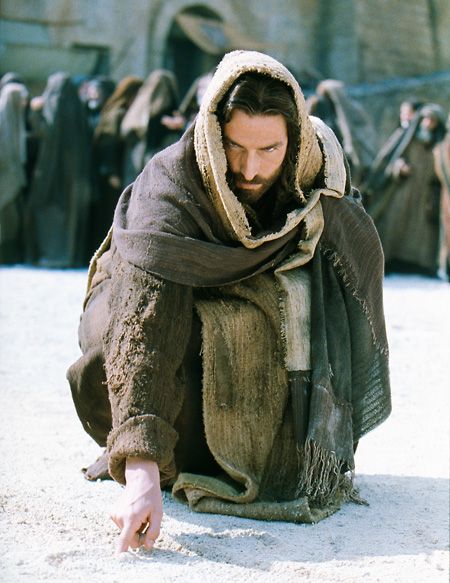







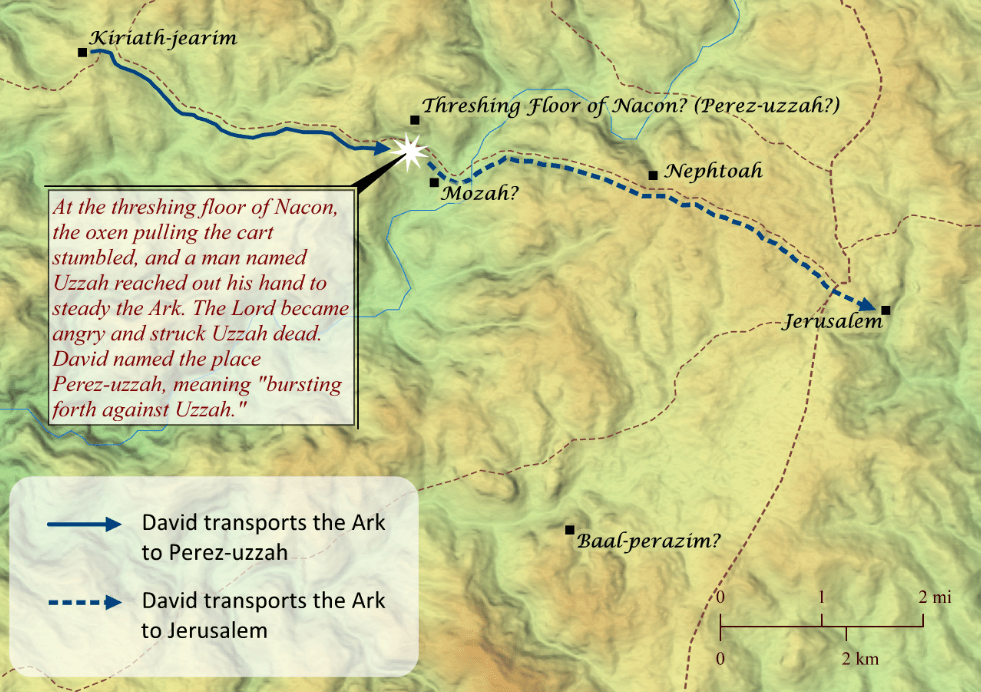
 Considering the Bible